Hybrid System Malfunction Warning: What It Means And What To Do
If your dashboard is showing a “Hybrid System Malfunction” or “Hybrid System Warning” message, your car is telling you that its computer has detected a fault somewhere in the hybrid drivetrain. It is not always an emergency, but it is not a warning to ignore either. This guide covers what the message actually means, whether you can keep driving, whether a reset will make it go away, and what causes it on the most common hybrid models.

What Does “Hybrid System Malfunction” Mean?
“Hybrid System Malfunction” is a general fault alert. It means the hybrid control computer has detected something it does not like across one or more of the hybrid components — the high voltage battery pack, the inverter, the electric motor generators, the hybrid transaxle, the cooling system, or the sensors that monitor all of them.
On Toyota vehicles, you will usually see the message worded as “Hybrid System Malfunction, Stop in a Safe Place” or “Hybrid System Malfunction, Visit Your Dealer”. On Lexus models, it appears as “Check Hybrid System” with a warning triangle. Ford Fusion Hybrids show “Stop Safely Now” for similar faults. Honda hybrids show “IMA System Warning” or “Check Hybrid System” depending on the generation.
The message itself does not tell you what is wrong. It only tells you that something is wrong. To find the actual fault, the car needs to be scanned for the underlying diagnostic trouble codes (DTCs) that triggered it.
Understanding the Hybrid System Malfunction Warning
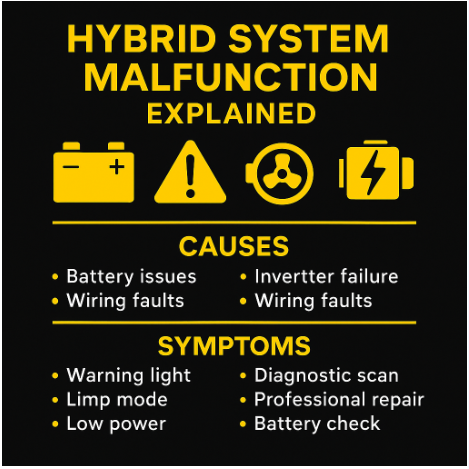
The “Hybrid System Malfunction” warning light indicates that the vehicle’s onboard diagnostics have detected an issue within the hybrid system. This system encompasses components such as:
- High-voltage battery pack
- Electric motor(s)
- Inverter/converter units
- Hybrid control modules
- Associated wiring and sensors
When a fault is detected in any of these components, the system triggers the warning light to alert the driver of potential issues that may affect the vehicle’s performance or safety.
Can You Drive With a Hybrid System Malfunction Warning?
The short answer depends on how the car is behaving.
Safe to drive short distances if:
- The car starts and drives normally
- Power delivery feels normal
- No loud noises, burning smells, or smoke
- Only the warning light is on
Stop driving immediately if:
- The dashboard message says “Stop in a Safe Place” or “Stop Safely Now”
- The car goes into reduced power (limp) mode
- You smell burning, hear grinding, or see smoke
- The brake pedal feels different or the regenerative braking has failed
- The car struggles to start or stalls unexpectedly
The Toyota-specific message “Stop in a Safe Place” is not a suggestion. It is the car telling you the fault is serious enough that continued driving may damage the hybrid system or become unsafe. Pull over, turn the vehicle off, and arrange a tow to a specialist.
When the warning is on but the car drives normally, most owners can complete their journey home or to a workshop safely. But do not defer diagnosis, an ignored hybrid warning that starts as a minor sensor fault often becomes an expensive main-battery replacement within weeks or months.
Can You Reset a Hybrid System Malfunction Warning?
Yes and no. You can clear the warning message using an OBD scanner or by disconnecting the 12V battery, but doing so will not fix the underlying problem. If the fault is still present, the warning will come back, sometimes immediately, sometimes on the next drive cycle, sometimes after a few days.
Resetting the warning without diagnosing the cause is one of the most common ways owners make small problems into large ones. A resettable code that keeps returning is usually the hybrid computer telling you the same fault is still there. Repeated resets that do not hold are a strong sign the battery, inverter, or a related sensor genuinely needs attention.
The only situation where a reset alone is appropriate is when the fault has been genuinely fixed (a repaired sensor, a cleaned cooling fan, a replaced 12V battery) and the code is left over from before the repair. Even then, the code should be cleared using a proper scan tool that reads and clears hybrid-specific codes, not a generic OBD-II reader.
What Causes a Hybrid System Malfunction?
Across the hybrid models we see most often, five root causes account for the majority of hybrid system malfunction warnings.
1. Weak or failing high-voltage battery pack
The most common cause across older Toyota and Lexus hybrids. As the main battery ages, individual cells or modules weaken. The hybrid computer detects the imbalance and throws a warning. Typical fault codes include P0A80 (replace hybrid battery pack), P0A7F (battery deterioration), and P0AFA (hybrid battery pack voltage low).
You can read the full breakdown in our hybrid fault code guide.
2. Cooling system failure
The high-voltage battery is cooled by a fan and a duct system. When the fan clogs with dust or the intake gets blocked, the battery overheats and the hybrid computer triggers a warning as a protective measure. This is one of the most common and most preventable causes of a hybrid system malfunction — and one of the cheapest to fix if caught early.
Read more in our hybrid battery cooling maintenance guide.
3. Weak 12V auxiliary battery
Hybrids have two batteries — the main high-voltage traction pack and a small 12V auxiliary. The 12V battery powers the computers that manage the main hybrid system. When the 12V is weak, the hybrid computer sees inconsistent voltage and often triggers a hybrid warning as a symptom, even though the main battery is fine.
If your hybrid warning appears alongside slow starting, dim lights, or electrical glitches, the 12V is a strong suspect. See our guide on how 12V batteries and hybrid systems interact.
4. Inverter or converter faults
The inverter converts DC from the battery into AC for the electric motors and back again. Inverter faults are less common than battery faults but more serious when they happen, because inverter replacement is expensive. Typical codes include P0A94 (DC/DC converter performance), P0A0A (high voltage system interlock circuit), and various P0A9x series codes.
5. Sensor and wiring faults
Hybrid systems rely on dozens of sensors monitoring voltage, current, temperature, and position. A single failed sensor or corroded connector can trigger a hybrid system malfunction warning while the actual battery, inverter, and motor are all healthy. Sensor-caused warnings are the cheapest to fix if diagnosed correctly, and the most expensive if misdiagnosed as a battery fault.
Hybrid System Malfunction on Specific Models
The general causes apply across brands, but the specifics vary. Here is what we see most often on the models this warning affects.
Toyota Prius
The most common hybrid car worldwide, and the one we see the most warnings on. On older Priuses (Gen 2, 2004–2009), a failing main battery is the dominant cause, the Gen 2 NiMH pack was less durable than later generations. On Gen 3 and Gen 4 Priuses, cooling fan blockage under the rear seat is the most common preventable cause. For all Priuses, generation-specific fault codes in the P3000 range often point to specific cell blocks.
Toyota Camry Hybrid
Camry Hybrid warnings vary by generation. The 40 Series (2007–2011, AHV40) and 50 Series (2012–2017, AVV50) use NiMH batteries and most warnings on high-mileage cars trace to weak modules or cooling issues. The 70 Series (2018–2021, AXVH70) switched to lithium-ion and behaves differently, warnings on the 70 tend to be earlier signs of degradation rather than immediate failures. See our Camry hybrid battery replacement options for the specific pack details.
Toyota Corolla Hybrid (2016 onwards)
The 2016-onwards Corolla Hybrid uses a compact NiMH pack under the rear seat. Cooling airflow to the under-seat pack is the most common warning cause. Fuel economy dropping from around 4.5L/100km toward 6 or 7 combined with the warning light is the classic early sign.
Toyota Yaris Hybrid
Yaris Hybrid warnings often relate to the smaller pack size, with fewer modules than a Camry or Prius, a single weak cell affects the whole pack more significantly. The warning may appear intermittently at first before becoming permanent.
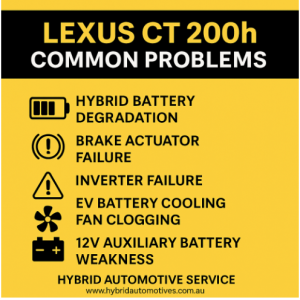
Lexus (CT200h, ES300h, NX300h, RX400h, RX450h, IS300h, GS450h)
Lexus hybrids share Toyota’s hybrid architecture, so the causes overlap. The Lexus dashboard message wording is “Check Hybrid System” rather than “Hybrid System Malfunction”, but the underlying diagnosis is the same. Older RX400h and GS450h models see more battery-age warnings; newer CT200h, NX300h, and ES300h models see more sensor and cooling-related warnings.
Toyota 48V Mild Hybrids (Yaris, Corolla, some Hilux markets)
The 48V mild hybrid system is different from the full hybrid system. On these cars a “48V system malfunction” warning usually points to the smaller 48V battery, the belt-driven starter-generator, or the associated wiring, not to a main traction battery (they do not have one). Diagnosis is different and typically simpler than for a full hybrid.
How to Diagnose the Real Cause
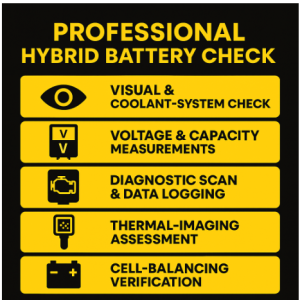
The warning message tells you almost nothing on its own. Proper diagnosis requires:
- A hybrid-specific diagnostic scan, not a generic OBD-II scan. Hybrid-specific codes in the P0A**, P3***, C13** and B ranges are often invisible to generic scanners.
- Module-level voltage testing on the high-voltage battery, to see whether individual cell blocks are healthy or degraded.
- Cooling system inspection — checking that the fan spins, the intake is clear, and airflow through the battery duct is unrestricted.
- 12V battery health check — measuring voltage, load response, and charging system output.
- Live data monitoring during a short drive, to see how the hybrid system behaves under real conditions rather than at idle.
A workshop that only reads the top-level fault code and quotes you for a battery replacement without doing the above is skipping the steps that catch cheaper causes. In our experience, roughly half of the “the dealer said I need a new battery” cases we see turn out to have a different underlying cause, once module-level testing is done.
What Does It Cost to Fix a Hybrid System Malfunction?
Cost varies enormously by cause. A rough guide:
- Sensor or wiring fault: low cost, often under $500 including diagnostic time
- 12V auxiliary battery replacement: $200–$400 depending on model
- Cooling fan clean and airflow restoration: typically $150–$300
- Individual battery module replacement (reconditioning): $800–$1,800 depending on model
- Full hybrid battery pack replacement (new aftermarket): $2,000–$4,500 depending on model
- Inverter replacement: $2,500–$5,000+, often making a full battery replacement more economical
Before any of the higher-cost options, insist on proper diagnostic evidence, not just a top-level scan code, but module-level test results showing why the recommendation is a battery or inverter rather than a cheaper fix.
For a full model-by-model cost breakdown, see our Toyota hybrid battery replacement cost guide.
When To Get Professional Help
Book a diagnostic if:
- The warning has appeared more than once, even if it resets each time
- The warning is combined with any change in fuel economy or performance
- The message specifically says “Stop in a Safe Place” or “Stop Safely Now”
- The car has entered limp mode or lost power
- Any other dashboard warning appears at the same time
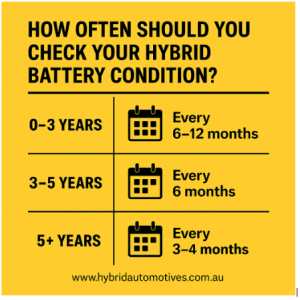
- You have not had the hybrid system checked in the last two years
A proper diagnostic scan usually pays for itself by identifying the actual fault before it grows into a bigger repair. Guessing wrong on a hybrid system warning is one of the more expensive mistakes an owner can make.
Symptoms Accompanying the Warning
When the hybrid system malfunction warning is active, you may notice:
- Reduced Fuel Efficiency: The vehicle may rely more on the gasoline engine, decreasing overall efficiency.
- Limited Power Output: The car might enter a “limp mode,” restricting speed and acceleration to prevent further damage.
- Unusual Noises: Whining or grinding sounds may emanate from the electric motor or inverter.
- Difficulty Starting: The vehicle may struggle to start or fail to start altogether.
Immediate Actions to Take
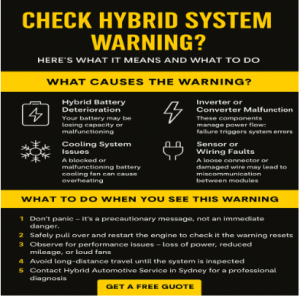
If the hybrid system malfunction warning appears:
- Safely Pull Over: If driving, find a safe location to stop the vehicle.
- Restart the Vehicle: Sometimes, restarting can reset the system. However, if the warning persists, further action is needed.
- Avoid Driving: Continuing to drive may cause additional damage. It’s advisable to have the vehicle inspected promptly.
- Consult a Professional: Schedule a diagnostic check with a qualified technician experienced in hybrid systems.
Diagnostic and Repair Process
Diagnosing a hybrid system malfunction involves:
- Computer Diagnostics: Using specialised tools to read error codes and identify faulty components.
- Physical Inspection: Checking wiring, connectors, and components for visible damage or wear.
- Performance Testing: Assessing the functionality of the battery, inverter, and motor under various conditions.
Repairs may range from software updates to component replacements. Costs can vary significantly based on the issue’s complexity and the parts involved. Contact Hybrid Automotive Service to Fix Hybrid System Malfunction Error.
Preventative Measures
To minimise the risk of hybrid system malfunctions:
- Regular Maintenance: Follow the manufacturer’s recommended service schedule.
- Monitor Battery Health: Keep an eye on battery performance and address issues promptly.
- Protect Electrical Components: Ensure that the vehicle’s electrical systems are shielded from moisture and contaminants.
- Stay Informed: Keep up-to-date with recalls or service bulletins related to your vehicle’s hybrid system.
Hybrid System Malfunction Warning FAQ
What does “Hybrid System Malfunction” mean?
It means your car’s hybrid control computer has detected a fault somewhere in the hybrid drivetrain, the battery, inverter, motors, cooling system, or sensors. The warning itself does not identify which component. Only a diagnostic scan reveals the specific fault code and cause.
Is it safe to drive with a hybrid system malfunction warning?
Sometimes yes, sometimes no. If the car drives normally and only the warning light is on, most short journeys are safe. If the message says “Stop in a Safe Place”, the car is in limp mode, or there is any burning smell, noise, or power loss, stop driving and arrange recovery.
Can I reset a hybrid system malfunction warning myself?
You can clear the code with an OBD scanner or by disconnecting the 12V battery, but if the underlying fault is still there, the warning will come back. Resetting without diagnosing rarely fixes anything, and repeated resets often make small problems worse.
How much does it cost to fix a hybrid system malfunction?
Anywhere from around $200 for a 12V battery to over $4,000 for a main battery pack replacement. Sensor and cooling faults are cheapest; battery and inverter faults are most expensive. Proper diagnosis is the only way to know which end of the range applies.
What does “Hybrid System Malfunction Visit Your Dealer” mean specifically?
This is a Toyota-specific version of the general warning telling you the car needs professional attention. It does not mean you have to go to a dealer specifically, an independent hybrid specialist can diagnose and repair the same faults, usually at lower cost.
How long can I drive with a hybrid system malfunction warning?
There is no fixed answer, some faults are safe to drive with for weeks, others require stopping immediately. The warning message wording is the best guide: “Visit Your Dealer” style messages usually allow limited driving, while “Stop in a Safe Place” messages mean stop now.
Does a hybrid system malfunction always mean I need a new battery?
No. Roughly half the cases we see turn out to be caused by cooling issues, weak 12V batteries, sensors, or wiring, all much cheaper to fix than a main battery replacement. Insist on module-level diagnostic evidence before agreeing to a battery replacement quote.