Do Hybrid Cars Have Alternators? How the 12V Battery Actually Gets Charged
The short answer is no. Most hybrid cars do not have a traditional alternator.
In a regular petrol or diesel car, the engine spins a belt that turns the alternator. That alternator generates electricity and keeps the 12-volt battery topped up while you drive. It’s been the standard setup for decades.
Hybrid cars took a different path. Because the petrol engine in a hybrid doesn’t run all the time — it shuts off at traffic lights, coasts on electric power at low speeds, and sometimes stays off for kilometres at a stretch — a belt-driven alternator would be unreliable. There would be long gaps where the engine is off, and nothing would be charging the 12V battery.
So Toyota, Honda, Hyundai, and every other hybrid manufacturer replaced the alternator with something called a DC-DC converter. This small electronic unit draws power from the high-voltage hybrid battery pack (which typically sits between 200 and 360 volts depending on the model) and steps it down to around 14 volts — exactly what the 12V battery and your car’s accessories need.
The result? No serpentine belt driving an alternator. No mechanical wear. And a system that works whether the petrol engine is running or not.
There are a few exceptions worth mentioning. Some mild hybrid systems (48-volt setups like those in certain Audi and Mercedes models) still use a belt-driven starter-generator that doubles as an alternator. And Toyota recently added a conventional alternator to the 2025 Tacoma hybrid — but only on models optioned with auxiliary power switches for aftermarket accessories. These are the exception, not the rule.
What Is a DC-DC Converter and How Does It Replace the Alternator?
Think of the DC-DC converter as the modern replacement for your alternator — except it has no moving parts, makes no noise, and works even when the engine is completely off.
Here’s what it actually does. Your hybrid has two separate electrical systems running side by side. There’s the high-voltage system (usually between 200V & 360V) that powers the electric motor & drives the wheels. Then there’s the low-voltage 12V system that runs everything else, your headlights, radio, power windows, dashboard instruments, central locking, and all the computers that manage the car.
These two systems need to talk to each other, but you can’t just wire 300 volts directly into a 12-volt circuit. That’s where the DC-DC converter comes in. It sits between the two systems & does one job, it takes high-voltage DC power from the hybrid battery and converts it down to a steady 12 to 14 volts.
The output is almost identical to what an alternator produces in a conventional car around 14.3 to 14.4 volts when the system is active. From the 12V battery’s perspective, there’s no practical difference. It receives a steady charge, stays topped up & powers all the accessories just like it would in any other car.
The big advantage is efficiency. An alternator creates drag on the engine because the engine has to physically spin it. That drag costs you fuel. A DC-DC converter has no mechanical connection to the engine at all. It draws from a battery that’s already been charged through a combination of the engine, the electric motor, & regenerative braking. There’s less wasted energy in the chain.
The other advantage is reliability. Alternators have bearings, brushes, a voltage regulator, and a belt that all wear out over time. A DC-DC converter is a solid-state electronic component. There are no moving parts to fail.
How Does a Hybrid Car Charge the 12V Battery?

This is the question we hear most often from hybrid owners, and the answer involves a chain of energy that’s more elegant than most people realise.
Here’s the full picture of how it works, step by step.
When you’re driving:
The petrol engine turns a motor-generator unit (called MG1 in Toyota’s system). This generates high-voltage AC electricity, which flows through the inverter and gets stored in the high-voltage battery pack. From there, the DC-DC converter continuously draws a small amount of power from the HV battery and converts it to 12–14 volts to keep the auxiliary battery charged. This happens automatically. You don’t have to do anything.
When you’re stopped but the car is in “Ready” mode:
Even if the petrol engine isn’t running and the car is sitting silently at a traffic light, the DC-DC converter is still working. As long as the dashboard shows “Ready” (or the power button is pressed and the car is on), the high-voltage system is active and the 12V battery is being maintained.
When the engine kicks in at idle:
If the high-voltage battery’s charge drops below a certain threshold while you’re parked in Ready mode, the petrol engine will start automatically. It runs MG1 to recharge the HV battery, which in turn feeds the DC-DC converter to keep the 12V system alive. You might notice this happening if you sit in your driveway with the car on for an extended period — the engine will occasionally cycle on and off.
When you brake (regenerative braking):
Every time you lift off the accelerator or press the brake pedal, the electric motor reverses its role and becomes a generator. It converts your car’s forward momentum (kinetic energy) back into electricity, which flows into the high-voltage battery. This indirectly supports the 12V system because there’s more energy available in the HV battery for the DC-DC converter to draw from.
For plug-in hybrids — when you’re plugged in:
If you own a PHEV and it’s connected to a charging station, the 12V battery also receives a charge during the process. The onboard charger fills the high-voltage battery from the mains, and the DC-DC converter simultaneously tops up the 12V battery. This means your 12V battery is less likely to drain flat if the car sits for a while, as long as it’s plugged in.
The key takeaway is that the 12V battery in a hybrid is never charging in isolation. It’s always part of a larger energy management system controlled by the car’s computer, which decides when and how much to charge based on the state of both batteries.
How Regenerative Braking Supports the Whole System
Regenerative braking is one of the cleverest features in a hybrid, and it plays a bigger role in charging than most owners appreciate.
In a conventional car, braking is pure waste. You press the brake pedal, the brake pads grip the rotors, and all that forward energy gets converted into heat and disappears into the air. You paid for the fuel that created that energy, and braking throws it away.
Hybrids recover a portion of it. When you lift your foot off the accelerator or begin braking, the electric motor switches from driving the wheels to being driven by them. In this reversed role, it works as a generator — converting your car’s kinetic energy back into electrical energy. That electricity flows through the inverter and gets stored in the high-voltage battery pack.
This recovered energy does two things. First, it extends the amount of time the car can run on electric power alone, which saves fuel. Second, it keeps the high-voltage battery topped up, which means the DC-DC converter always has a healthy energy source to draw from when charging the 12V battery.
The amount of energy recovered varies. In city driving with frequent stops, regenerative braking recovers significantly more than on a motorway cruise where you rarely brake. This is one of the reasons hybrids are particularly fuel-efficient in urban conditions.
Regenerative braking also reduces wear on the conventional brake pads and rotors. Since the electric motor handles much of the deceleration, the friction brakes don’t work as hard. It’s not unusual for hybrid owners to get 80,000 to 100,000 km from a set of brake pads — roughly double what you’d expect from a conventional car.
Not All Hybrids Are Built the Same — How Each Type Charges the 12V Battery
The word “hybrid” covers a wide range of vehicles, and the way each type handles the 12V battery is different. Here’s a breakdown.
Micro Hybrids (Start-Stop Systems)
These are barely hybrids at all. They have a conventional engine with a beefed-up starter motor and a start-stop system that shuts the engine off at red lights. They still have a traditional alternator on a belt, and the 12V battery charges exactly like it would in any other car. The “hybrid” label here is mostly marketing.
Mild Hybrids (48-Volt Systems)
Mild hybrids — common in newer Audi, Mercedes, and some Suzuki models — use a 48-volt battery and a belt-driven starter-generator (BSG). The BSG replaces both the starter motor and the alternator. It starts the engine, assists during acceleration, and charges both the 48V and 12V batteries through a DC-DC converter. So while there’s no traditional alternator, the BSG is essentially a smarter, more efficient version of one.
Full Hybrids (Toyota Hybrid Synergy Drive, Honda IMA)
This is where the alternator truly disappears. Full hybrids like the Toyota Prius, Camry Hybrid, Corolla Hybrid, and Lexus models use two motor-generators (MG1 and MG2) integrated into the transmission. MG1 handles starting the engine and generating electricity. MG2 drives the wheels and handles regenerative braking. The high-voltage battery charges from both, and a DC-DC converter steps the voltage down for the 12V system. There is no belt, no alternator, and no starter motor in the traditional sense.
Plug-In Hybrids (PHEVs)
Plug-in hybrids like the Toyota Prius Prime, Mitsubishi Outlander PHEV, and Hyundai Ioniq Plug-In work the same way as full hybrids when driving. The difference is they also charge from the mains when plugged in. During mains charging, the DC-DC converter keeps the 12V battery topped up as well. No alternator is present in any current PHEV model.
Battery Electric Vehicles (BEVs)
Fully electric cars like the Tesla Model 3, Hyundai Ioniq 5, and Nissan Leaf have no petrol engine at all — and obviously no alternator. They rely entirely on a DC-DC converter to step down from the high-voltage battery (often 400V or 800V) to charge the 12V auxiliary battery. Every system in the car runs from the 12V battery or the HV battery, with the DC-DC converter as the bridge between them.
Does Your Specific Hybrid Have an Alternator? A Model-by-Model Answer
We service hundreds of hybrid vehicles every year at our workshop in Sydney, and these are the models we get asked about most.
Toyota Prius (All Generations)
No alternator. Every generation of the Prius — from the original NHW10 through to the current fifth-generation model — uses Toyota’s Hybrid Synergy Drive system. MG1 generates electricity, the inverter manages power flow, and a DC-DC converter charges the 12V battery. There has never been a belt-driven alternator fitted to any Prius. The 12V battery in most Prius models is a small AGM (Absorbed Glass Mat) battery located in the boot, not under the bonnet. If the problem is the high-voltage pack rather than the 12V, see our Prius hybrid battery replacement options.
Toyota Camry Hybrid
No alternator. The Camry Hybrid uses the same Hybrid Synergy Drive architecture as the Prius but with a larger engine and more powerful motor-generators. The high-voltage battery pack typically runs at 244.8 volts (in the 70-series Camry), and the DC-DC converter steps this down for the 12V system. We see 12V battery issues in Camry Hybrids more often than you’d expect — usually after 4 to 5 years, especially in cars that sit unused for long periods.
Toyota Yaris Cross Hybrid
No alternator. The Yaris Cross uses a 1.5-litre hybrid system with a smaller HV battery pack. A known issue with this model is the 12V battery going flat if the car is only used for very short trips. The DC-DC converter charges the 12V battery when the car is in Ready mode, but short drives may not provide enough charging time. If you regularly drive less than 10 minutes at a time, consider using a trickle charger on the 12V battery every couple of weeks.
Toyota Corolla Hybrid
No alternator. Same hybrid architecture as the Yaris Cross — 1.8-litre or 2.0-litre hybrid depending on the market. The 12V battery sits in the boot. Same short-trip charging concern applies.
Honda Civic Hybrid (All Generations)
No alternator. Honda’s IMA (Integrated Motor Assist) system uses a thin electric motor sandwiched between the petrol engine and transmission. This motor doubles as a generator and feeds a high-voltage battery pack. A DC-DC converter handles the 12V charging. No Honda Civic Hybrid ever came with a factory-fitted alternator, despite what some aftermarket parts listings might suggest.
Hyundai Elantra Hybrid / Ioniq Hybrid
No traditional alternator. Hyundai’s hybrid system uses a Hybrid Starter Generator (HSG) that replaces both the starter motor and the alternator. The HSG charges the high-voltage battery, and a DC-DC converter steps down to 12V. The 2024 Elantra Hybrid has been a common search query — people wondering if it has a conventional alternator. It does not.
Lexus CT200h, RX450h, ES300h, NX300h
No alternator on any Lexus hybrid model. Lexus uses the same Toyota Hybrid Synergy Drive platform across its lineup. The RX450h uses a 288-volt battery pack, the CT200h runs at 201.6 volts. All use DC-DC converters. We service these regularly and have dedicated guides for each model on our site.
DC-DC Converter vs Alternator — A Proper Comparison
| Traditional Alternator | DC-DC Converter (Hybrids) | |
| Power source | Engine crankshaft via serpentine belt | High-voltage hybrid battery pack |
| Output | ~12–14V DC | ~12–14V DC |
| Works when engine is off? | No — engine must be running | Yes — works whenever the car is in Ready mode |
| Moving parts | Rotor, bearings, brushes, belt pulley | None — solid-state electronics |
| Typical lifespan | 100,000–200,000 km | Usually lasts the life of the vehicle (10+ years) |
| Common failure points | Worn bearings, failed voltage regulator, broken belt | Capacitor degradation, solder joint failure (rare) |
| Maintenance required | Belt tension checks, belt replacement every 60,000–100,000 km | None under normal conditions |
| Effect on fuel economy | Creates parasitic drag on the engine (1–3% fuel penalty) | No mechanical drag — draws from battery electronically |
| Noise | Whining noise when worn | Silent |
| Weight | 4–7 kg | 1–3 kg |
| Replacement cost (Australia) | $300–$800 fitted | $500–$1,500 fitted (less common to fail) |
The DC-DC converter is objectively the better technology for this job. It’s lighter, quieter, more efficient, and more reliable. The only drawback is that when it does fail, it tends to be a more expensive repair because the parts are specialised and not every mechanic is trained to work on hybrid high-voltage systems.
Common 12V Battery Problems in Hybrids — What to Watch For
Even though the DC-DC converter is more reliable than an alternator, the 12V battery itself is still a weak point in many hybrid vehicles. We replace more 12V batteries in hybrids than most people would expect.
Here’s why. The 12V battery in a hybrid is smaller and lighter than the one in a conventional car. It doesn’t need to crank a starter motor (the hybrid system handles that), so manufacturers use a compact AGM battery — often just 36 to 46 amp-hours. But this smaller battery still has to power a surprisingly demanding load of electronics: multiple control modules, keyless entry receivers, security systems, and telematics units that draw small amounts of power even when the car is parked.
This parasitic draw is the main reason hybrid 12V batteries die faster than you’d think. If the car sits for a week or two without being driven, those electronics can drain the small battery flat.
Symptoms of a Weak 12V Battery in a Hybrid
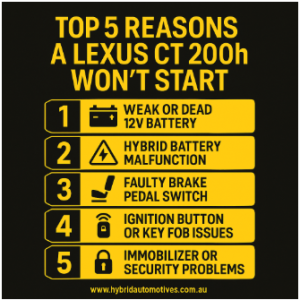
- “Check Hybrid System” warning light — This is the most common sign. Many owners panic when they see this message, assuming the expensive hybrid battery is failing. More often than not, it’s the cheap 12V battery that’s the problem.
- Car won’t start or enter Ready mode — The 12V battery provides the initial power to close the high-voltage contactors. If the 12V battery is flat, the car simply cannot wake up the hybrid system.
- Dashboard lights flickering or going dim — Inconsistent 12V supply causes all sorts of strange electrical behaviour.
- Remote key fob not locking or unlocking — The receiver module runs on 12V power.
- Infotainment system resetting or behaving erratically — Another common symptom of low 12V voltage.
What Causes the 12V Battery to Fail Prematurely?
- Short trips that don’t give the DC-DC converter enough time to fully charge the 12V battery
- Leaving the car parked for extended periods (more than a week) without driving
- Extreme heat — Australia’s summer temperatures are brutal on small AGM batteries
- Age — expect 3 to 5 years from a hybrid 12V battery, compared to 4 to 6 years for a conventional car battery
- Aftermarket accessories (dashcams, GPS trackers) drawing power when the car is off
If you’re experiencing any of these symptoms, get the 12V battery tested before assuming the worst about your hybrid system. A $150 to $250 battery replacement solves the problem in the majority of cases.
Can a Hybrid Car Run Without the 12V Battery?
No. This catches a lot of people off guard, but the small 12V battery is absolutely essential — even in a car with a massive hybrid battery pack worth thousands of dollars.
Here’s why. The high-voltage battery in your hybrid is isolated behind safety contactors (heavy-duty relays) that disconnect it from the rest of the car when the vehicle is off. This is a critical safety feature — you don’t want 200+ volts accessible at all times, especially in a crash.
When you press the start button, it’s the 12V battery that powers the computer, which then sends a signal to close those contactors and connect the high-voltage battery to the system. Without the 12V battery, the car has no way to wake up the hybrid system. It doesn’t matter if your hybrid battery is at 100% charge — if the 12V battery is dead, the car won’t start.
This is also why you can’t just disconnect the 12V battery to save power while the car is parked for months. When you reconnect it, the car should start normally, but the system may need to recalibrate certain settings.
If your 12V battery dies while you’re driving, the car won’t immediately shut down. The DC-DC converter is still supplying 12V power from the HV battery. But if you turn the car off, you won’t be able to restart it until the 12V battery is either recharged or replaced.
How to Charge a Hybrid 12V Battery
If your hybrid’s 12V battery has gone flat — or you want to keep it healthy — here are your options.
Option 1: Drive the Car
The simplest method. Start the car (or jump-start it if needed) and drive for at least 20 to 30 minutes. The DC-DC converter will recharge the 12V battery from the high-voltage system as you drive. Highway driving is slightly better than city driving for this purpose because the system runs more consistently.
Option 2: Leave the Car in Ready Mode
If you can’t drive, turn the car on and leave it in Ready mode (foot on brake, press power button, wait for “Ready” to appear on the dash). Leave it running for 30 to 60 minutes. The petrol engine will cycle on and off as needed to maintain the HV battery, and the DC-DC converter will charge the 12V battery. Do this in a well-ventilated area — never in a closed garage.
Option 3: Use a Trickle Charger or Smart Charger
This is the best option if the car has been sitting for a while. Connect a smart battery charger (sometimes called a trickle charger or battery maintainer) directly to the 12V battery terminals. Use a charger rated for AGM batteries if your hybrid uses one (most do). A 2-amp to 4-amp charger is ideal — avoid high-amperage fast chargers, which can damage the small battery.
For Toyota hybrids, the 12V battery is usually in the boot (rear of the car). There are often jump-start terminals under the bonnet, but for trickle charging, connect directly to the battery.
Option 4: Jump-Start From Another Car
Yes, you can jump-start a hybrid. Connect the positive cable to the positive jump-start terminal (usually under the bonnet) and the negative cable to an unpainted metal ground point — not directly to the negative battery terminal. Start the other car first, wait a minute, then start your hybrid. Once it’s running, drive for at least 30 minutes to let the DC-DC converter do its job.
Important: Do not use a hybrid to jump-start another car unless the manufacturer specifically says it’s safe to do so. The 12V system in most hybrids is not designed to supply the high cranking amps needed to start a conventional car’s engine, and attempting it can damage the DC-DC converter or blow a fuse.
Prevention
If you don’t drive your hybrid regularly (less than once a week), the best investment is a smart battery maintainer. Leave it connected when the car is parked. They cost $50 to $100 and will save you from flat-battery callouts.
Hybrid Battery Voltage — What Voltage Does Your Hybrid Actually Run On?
One of the most common questions we get is about hybrid battery voltage. People hear “high-voltage” and want to know exactly how high.
The answer depends entirely on the model. Here are the high-voltage battery pack voltages for the most popular hybrids in Australia.
| Vehicle | HV Battery Voltage | HV Battery Type | 12V Battery Type |
| Toyota Prius (Gen 2, NHW20) | 201.6V | NiMH | 12V AGM |
| Toyota Prius (Gen 3, ZVW30) | 201.6V | NiMH | 12V AGM |
| Toyota Prius (Gen 4, ZVW50) | 207.2V | NiMH or Li-ion | 12V AGM |
| Toyota Camry Hybrid (AVV50/AXVH70) | 244.8V | NiMH | 12V AGM |
| Toyota Corolla Hybrid | 177.6V | NiMH | 12V AGM |
| Toyota Yaris Cross Hybrid | 177.6V | NiMH | 12V AGM |
| Toyota Aqua / Prius C | 144V | NiMH | 12V AGM |
| Toyota RAV4 Hybrid | 244.8V | NiMH | 12V AGM |
| Lexus CT200h | 201.6V | NiMH | 12V AGM |
| Lexus RX450h | 288V | NiMH | 12V AGM |
| Lexus ES300h | 244.8V | NiMH | 12V AGM |
| Lexus NX300h | 244.8V | NiMH | 12V AGM |
| Honda Civic Hybrid | 158.4V | NiMH | 12V Lead-acid |
| Honda CR-Z | 100.8V | Li-ion | 12V Lead-acid |
| Hyundai Ioniq Hybrid | 240V | Li-ion Polymer | 12V AGM |
All of these voltages are stepped down to approximately 12–14 volts by the DC-DC converter to charge the auxiliary battery and run the car’s accessories. The DC-DC converter handles this regardless of whether the input voltage is 100V or 360V — it’s designed to work across a range.
A quick note on safety: these are dangerous voltages. The high-voltage battery, cables (usually marked with bright orange insulation), and the DC-DC converter should only be serviced by a qualified hybrid technician. Do not attempt to test or work on the high-voltage system yourself.
Frequently Asked Questions
Does a Toyota Prius have an alternator?
No. No generation of the Toyota Prius has ever been fitted with a conventional alternator. The Prius uses two motor-generators (MG1 and MG2) integrated into its hybrid transaxle. MG1 generates electricity from the petrol engine, and the energy is stored in the high-voltage battery pack. A DC-DC converter then steps the voltage down from 201.6V (or 207.2V in newer models) to charge the 12V auxiliary battery.
Does a hybrid car have a regular car battery?
Yes. Every hybrid has a standard 12-volt battery in addition to the large high-voltage hybrid battery. The 12V battery powers the car’s electronics, locks, lights, and computers. In most Toyota and Lexus hybrids, this is a small AGM battery located in the boot. It’s a regular automotive battery that can be tested and replaced at any battery shop or hybrid specialist.
What charges the 12V battery in a hybrid?
A component called a DC-DC converter. It takes power from the high-voltage hybrid battery and converts it to approximately 12–14 volts to keep the auxiliary battery charged and power the car’s accessories. It works whenever the car is in Ready mode, whether the petrol engine is running or not.
How does a hybrid car charge its battery while driving?
Two ways. First, the petrol engine runs the motor-generator (MG1), which produces electricity that charges the high-voltage battery. Second, regenerative braking captures energy during deceleration and sends it back to the high-voltage battery. The DC-DC converter continuously draws from the HV battery to keep the 12V system topped up throughout.
Do hybrid cars need to be charged?
Conventional hybrids (like the Prius, Camry Hybrid, and Corolla Hybrid) do not need to be plugged in. They charge themselves through the petrol engine and regenerative braking. Plug-in hybrids (PHEVs) can be plugged in to charge the high-voltage battery from the mains, but they can also drive without being plugged in — they just won’t have as much electric-only range.
Can a hybrid car run without the hybrid battery?
In most cases, no. The hybrid battery is integral to the powertrain. Without it, the electric motor can’t assist the engine, and in many hybrids (particularly Toyota models), the engine physically cannot start without the motor-generator powered by the HV battery. Some older Honda hybrids could limp along on the petrol engine alone, but performance was severely degraded and the car would throw multiple warning lights.
Do electric cars have alternators?
No. Fully electric cars (BEVs) have no petrol engine and therefore no alternator. They use a DC-DC converter to step down from the high-voltage traction battery (usually 400V or 800V) to charge the 12V auxiliary battery. The principle is exactly the same as in a hybrid.
How long does a 12V battery last in a hybrid?
Typically 3 to 5 years in Australian conditions. Heat accelerates battery degradation, and the smaller AGM batteries used in hybrids are more sensitive to temperature extremes than the larger batteries in conventional cars. If your hybrid sits unused for long periods or you only take short trips, the 12V battery may fail sooner. We recommend having it tested annually after the 3-year mark.
What does it cost to replace a 12V battery in a hybrid?
In Australia, a replacement 12V battery for most Toyota and Lexus hybrids costs between $150 and $300 for the battery, plus $50 to $100 for fitting. This is comparable to a conventional car battery replacement. The hybrid high-voltage battery is a separate (and much more expensive) component — don’t confuse the two.
Does the DC-DC converter ever fail?
It can, but it’s uncommon. DC-DC converter failures typically occur after 10 or more years and present as the 12V battery repeatedly going flat even after replacement, charging system warning lights, or intermittent electrical gremlins. Replacement cost varies by model but is usually between $500 and $1,500 including labour at a hybrid specialist workshop.